 Duro
Your control muscle
The muscle the gym forgets.
Your pelvic floor helps hold back ejaculation and keeps blood in your erection. Like any muscle, you can train it. Try one now. It takes 30 seconds.
Squeeze as if you were stopping a wee. Keep your bum, belly and thighs relaxed.
Nice one. In Duro there are 5 levels like this, guided step by step, with a 3D model showing you the move.
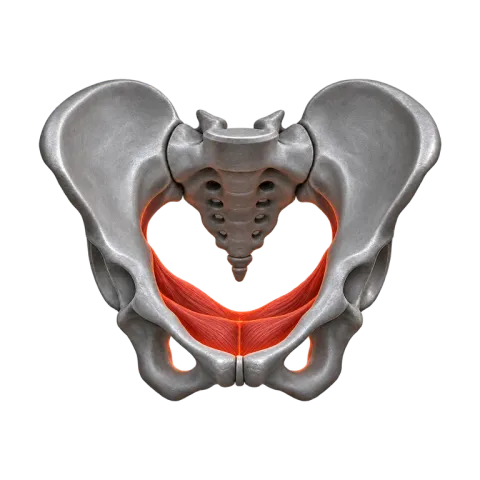
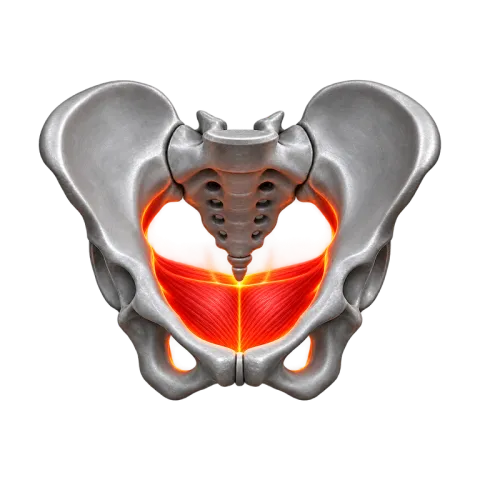
Pelvic floor exercises (Kegels, if you’ve picked the word up online) are the same thing: squeezing and relaxing the sling of muscle under your bladder and behind your balls. They’re free, invisible and take a few minutes a day. The hard part isn’t the effort. It’s finding the right muscle and sticking with it long enough.
This guide covers how to find it, a week-by-week 12-week plan, the mistakes most men make, and an honest summary of what the research found.
What is the pelvic floor, and why does it matter for sex?
The pelvic floor is a group of muscles running from your pubic bone to your tailbone. It supports your bladder and bowel, and it plays a part in sex.
Two of these muscles wrap around the base of the penis. They help keep blood in the penis during an erection, and they contract rhythmically when you ejaculate. That’s why an NHS hospital leaflet describes them as important for keeping an erection and avoiding premature ejaculation.
One detail matters, though. In a 2025 study, men who came too quickly didn’t have a weaker pelvic floor than men who didn’t. So the point of training is less about raw strength and more about control: knowing where the muscle is, and being able to tighten and let go on purpose.
How do you find your pelvic floor muscles?
Relax your thighs, bum and stomach, then squeeze as if holding in wind and stopping a wee midstream: you should feel a lift behind the scrotum, and in a mirror the base of the penis pulls in and the testicles rise (Continence Health Australia). Don’t use stopping your wee as an exercise: the NHS Gloucestershire leaflet says to test it no more than once a fortnight. If it doesn’t click, our guide on how to find your pelvic floor has four simple checks, and a specialist pelvic health physiotherapist can help if you still can’t feel anything.
How many reps should you do, and how often?
The NHS Gloucestershire routine is a sensible baseline:
| Exercise | What to do | Amount |
|---|---|---|
| Slow holds | Squeeze and lift, hold as long as you can (up to 10 seconds), then rest for 10 seconds | 8 in a row |
| Quick squeezes | Short, strong lifts, letting go fully each time | 8 in a row |
| Frequency | One set of each | 3 times a day |
If you can only hold for 3 seconds, that’s fine. Keep that count, then build to 4, then 5. Start sitting or lying down. Once that’s easy, move to standing.
The 12-week plan, week by week
This plan is ours. It’s modelled on the NHS Gloucestershire leaflet, the home routine in the Dorey trial (squeezes lying, sitting and standing, morning and evening) and the 12-week timeframe used by Pastore and colleagues. It hasn’t been tested as a programme in its own right, so treat it as a structure, not a promise.
| Weeks | Focus | Slow holds | Quick squeezes | Position |
|---|---|---|---|---|
| 1–2 | Find the muscle, learn to relax it | 3–5 s, rest the same | 5–8 | Lying or sitting |
| 3–4 | Build the habit | 5–6 s, rest 6 s | 8 | Sitting, then standing |
| 5–6 | Endurance | 7–8 s, rest 8 s | 8 | Lying, sitting and standing |
| 7–8 | Full NHS routine | 10 s, rest 10 s | 8 | All three, plus while walking |
| 9–10 | Control | 10 s holds + half-strength squeezes | 8 fast, full release each time | Standing |
| 11–12 | Bring it into real life | Keep the full routine | 8 | Any, plus during solo sex |
What to add along the way:
- Weeks 1–2: after each squeeze, notice the muscle drop back down. If you can’t feel the release, slow everything down.
- Weeks 5–6: add a firm squeeze after you wee. It was part of the Dorey home routine.
- Weeks 7–8: practise a light squeeze (about half effort) while walking, also borrowed from Dorey.
- Weeks 9–10: breathe out slowly as you squeeze, breathe in as you let go. Pair it with a slow breathing pattern (more in our guide to breathing to last longer).
- Weeks 11–12: during solo sex, practise noticing your arousal and pausing when you get close, the stop-start technique. In one study, men combined daily squeezes with a brief contraction at penetration and stop-start during sex.
After week 12, don’t stop. Drop to a maintenance routine of one full set a day.
How often, and when will you notice a difference?
These are the questions men ask most about Kegel exercises for men, so here are straight answers from the NHS Gloucestershire leaflet and the research.
How many times a day should you do them?
The leaflet’s routine is 8 slow holds (up to 10 seconds each, with 10 seconds’ rest) followed by 8 quick squeezes, done 3 times a day. That’s a few minutes in total. If you can only hold for 3 seconds, start there and add a second at a time.
Can you do too many?
More isn’t better. Stick to the routine, rest as long as you held, and stop if anything hurts: pain is a reason to get checked, not to squeeze harder.
Where should you do them?
Start sitting or lying down, where it’s easiest to isolate the muscle. Once that’s easy, do them standing, and later during everyday moments like waiting for the kettle, so the habit sticks.
When will you notice a change?
Be patient. The leaflet says you probably won’t notice a change for several weeks, and the best results usually take 3 to 6 months of daily practice; if there’s little or no change after 3 months, it advises seeing a health professional. Research on ejaculation control tends to measure progress at 6 and 12 weeks, but that doesn’t mean everyone improves by then: results vary a lot from man to man, and nobody can promise you a timeline.
Do you have to keep going after 12 weeks?
In a follow-up study, most men kept their control at two years, but the gains tend to fade if you stop completely. A few sessions a week is a sensible way to keep it ticking over.
What are the most common mistakes?
- Holding your breath. Keep breathing normally. Breath-holding tends to bring your stomach and bum into the squeeze.
- Clenching your bum, thighs or stomach. If your buttocks lift off the chair, you’re using the wrong muscles. Put a hand on your stomach: it should stay soft.
- Pushing down instead of lifting up. The movement is a lift, as if drawing everything up and in. Bearing down is the opposite.
- Training on the toilet. Stopping your wee is a one-off test, not the workout.
- Not letting go. A muscle that never relaxes isn’t under control. Rest as long as you held. Our guide to reverse Kegels covers the relaxing side.
- Confusing Kegels and reverse Kegels. A reverse Kegel means deliberately relaxing and dropping the pelvic floor. It’s popular on TikTok, and learning to relax is useful, but no trial has tested it alone for premature ejaculation.
- Squeezing through pain. Pain in the pelvis, during sex or when you come is a reason to stop and get checked, not to squeeze harder. See your GP.
- Giving up at week three. In the research, missed sessions and dropping out come up again and again.
What do the studies actually say?
Short version: promising, but not proven. Here’s what the main studies found, with their limits.
| Study | Who | What they found | Limits |
|---|---|---|---|
| Pastore, 2014 | 40 men with lifelong premature ejaculation | After 12 weeks, 33 of 40 gained control; average time to ejaculation went from 31.7 to 146.2 seconds | No control group; clinic sessions with electrical stimulation and biofeedback, not just home Kegels |
| Pastore, 2018 | 122 men who finished the same programme | 64% still had control at 24 months, 56% at 36 months | Looked back at records; no control group |
| Lyu, 2025 | 124 men who completed 8 weeks | Median times rose (from 30 to 60 seconds in lifelong PE) | No sham or placebo group; times were self-estimated |
| de Oliveira, 2026 | 5 trials, 236 men | Exercises alone did worse than medication or exercises combined with diaphragmatic breathing | Small, very mixed trials |
| Dorey, 2004 | 55 UK men with erection problems | 40% regained normal erections and about 35% improved after training with biofeedback plus lifestyle advice | Small trial; included physio sessions with biofeedback |
| Myers & Smith, 2019 | Review of 10 trials | Training seems to help both erection problems and premature ejaculation | Low to moderate quality; no best protocol identified |
Two honest takeaways. First, the best results came from supervised programmes, not an app or a leaflet alone. Second, squeezing on its own seems to do less than squeezing combined with breathing and arousal control. If coming too quickly is your main issue, read what premature ejaculation is and our guide to premature ejaculation exercises. Treatments from your GP exist and work for many men, and exercises can be done alongside them.
Can an app help you stick with it?
Consistency is where most men fall down, and a reminder plus a guided session can help: Duro is an iPhone app that runs a 5-minute daily session of guided pelvic floor work over 5 levels, breathing and challenges (a training programme, not a medical treatment, and Duro is currently in French only). How to choose an app, with a factual comparison, is in our guide to the best Kegel app for men.
When should you see a GP?
Exercises are fine to start on your own, but talk to your GP or a pelvic health physiotherapist if nothing has changed after 3 months of regular practice. See a doctor promptly if:
- you have pain in your pelvis, testicles or penis, during sex or when you ejaculate;
- there is blood in your urine or semen;
- the problem started suddenly after years without trouble;
- you also struggle to get or keep an erection: the British Heart Foundation says erection problems can be an early warning sign of heart disease;
- it is weighing on your mood or your relationship.
For who to see and what happens at the appointment, read when to see your GP.
Your GP can refer you to a specialist pelvic health physiotherapist, who can check your technique properly. That’s not a failure: in the studies, that kind of support is exactly what the men who improved had.
FAQ
How do men find their pelvic floor muscles?
Sit with your thighs, bum and stomach relaxed, then tighten as if you were holding in wind and stopping a wee midstream. You should feel a lift behind the scrotum, and in a mirror the base of the penis pulls in and your testicles rise slightly.
How many pelvic floor exercises should a man do a day?
A common NHS routine is 8 slow holds (up to 10 seconds, with 10 seconds' rest) followed by 8 quick squeezes, done 3 times a day. If you can only hold for 3 seconds, start there and add a second at a time.
How long do pelvic floor exercises take to work for men?
NHS Gloucestershire says you probably won't notice a change for several weeks, and the best results usually take 3 to 6 months of daily practice. Studies on ejaculation control measured progress at 6 and 12 weeks, but results vary and nothing is guaranteed.
Do Kegels help you last longer in bed?
Some studies found men gained more control after 8 to 12 weeks of pelvic floor training, but most had no control group and the evidence is still limited. A 2026 meta-analysis suggests exercises work better combined with breathing than on their own.
What is a reverse Kegel?
It means consciously relaxing and lowering the pelvic floor rather than squeezing it. Learning to let go fully is part of any good routine, but no trial has tested reverse Kegels on their own for premature ejaculation.
Can Kegels be bad for you?
If you feel pain in the pelvis, during sex or when you come, more squeezing isn't the answer. Stop and talk to your GP, who can check what's going on and refer you to a specialist pelvic health physiotherapist if needed.
Sources
- Gloucestershire Hospitals NHS Foundation Trust, patient leaflet GHPI0322_07_25, 2025 — Pelvic floor exercises for men
- Continence Health Australia — Pelvic floor exercises for men
- Dorey et al., British Journal of General Practice, 2004 — Pelvic floor exercises for erectile dysfunction (randomised trial)
- Pastore et al., Therapeutic Advances in Urology, 2014 — Pelvic floor rehabilitation for lifelong premature ejaculation
- Pastore et al., Asian Journal of Andrology, 2018 — Long-term follow-up of pelvic floor rehabilitation for premature ejaculation
- Lyu et al., Sexual Medicine, 2025 — Pelvic floor training in lifelong and acquired premature ejaculation
- de Oliveira et al., Journal of Sexual Medicine, 2026 — Meta-analysis of pelvic floor exercises for premature ejaculation
- Myers & Smith, Physiotherapy, 2019 — Systematic review of pelvic floor training for erectile dysfunction and premature ejaculation
Information written with the help of AI from the sources cited, then checked. It is not a substitute for medical advice: if you have pain, a sudden problem or any doubt, talk to your GP.