 Duro
The control muscle
The muscle your gym skips.
Your pelvic floor is involved in ejaculation and helps keep blood in your erection. Like any muscle, you can train it. Try it now. It takes 30 seconds.
Squeeze like you're stopping your pee midstream. Keep your butt, abs and thighs relaxed.
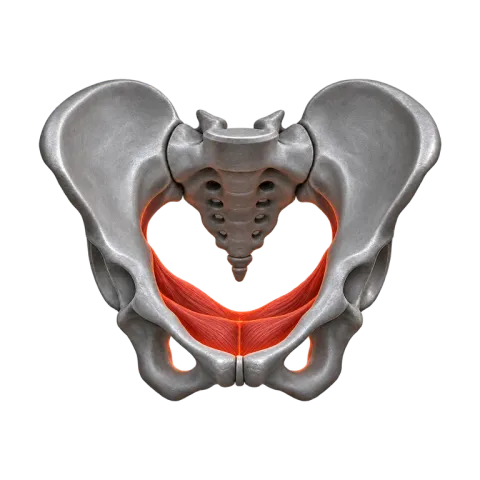
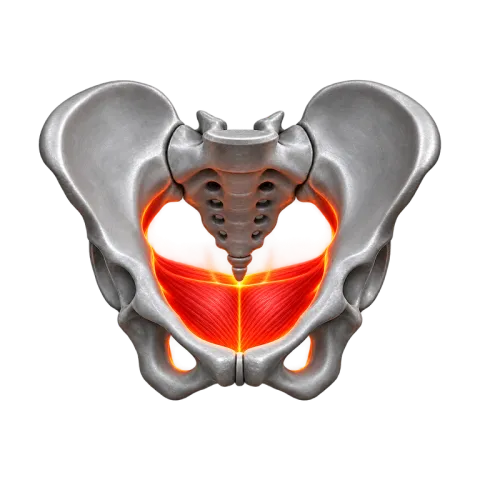
Nice. In Duro, there are 5 levels like this, with a 3D model that shows you every move.
A lot of guys who try Kegels quit early. Not because the exercise is hard, but because nobody told them which muscle to squeeze, how many reps to do, or when they’d notice anything. So they clench their butt for a few days, feel nothing and move on.
This guide fixes that order of operations. First you find the right muscle (it takes about two minutes). Then you follow a 12-week plan modeled on what researchers actually tested. Then you avoid the five mistakes that waste most men’s effort. And you get an honest read of the science, including where it falls short.
What is a Kegel for men, exactly?
A Kegel is a squeeze-and-release of your pelvic floor: the sling of muscle between your tailbone and your pubic bone, under your balls. Two of those muscles (the bulbospongiosus and ischiocavernosus) wrap the base of your penis. They help keep blood in the penis during an erection and they contract rhythmically when you ejaculate.
That’s the whole logic behind Kegels for sex. If you can feel and control those muscles on purpose, you may get a bit more say over your erection and over the moment you come.
The International Society for Sexual Medicine lists pelvic floor exercises among the options for premature ejaculation, next to the stop-start and squeeze techniques, numbing products and medication.
How do you find the right muscle?
Squeeze as if you’re trying not to pass gas in a quiet room, keeping your butt, thighs and abs soft, then let the muscle go completely. In front of a mirror, the base of your penis should move in toward your body and your testicles should lift slightly, according to Continence Health Australia. If that doesn’t click, try the four cues and the 2-minute self-test in how to find your pelvic floor muscles.
How many Kegels a day? The basic set
Patient guides converge on a simple formula. Continence Health Australia suggests building up to 3 sets a day, each made of:
- Slow holds: squeeze, hold for 3 seconds at first, working up to 5 to 8 seconds, then rest for the same time. Start with 3 to 5 reps and build to 8 to 10.
- Quick squeezes: 8 to 10 short, strong flicks, fully releasing each time.
That’s about five minutes a day. In the Dorey trial on erectile dysfunction, men did 3 maximum squeezes lying down, 3 sitting and 3 standing, morning and evening, for six months, plus a firm squeeze after peeing and light squeezes while walking.
The 12-week Kegel plan, week by week
This is a home version built on the timelines and exercise types from the studies below. It is not the exact study protocol: in the Pastore trials, men also had in-clinic sessions with electrical stimulation and biofeedback three times a week, which you can’t copy on your couch.
| Weeks | Position | Slow holds (per set) | Quick squeezes | Sets/day | Focus |
|---|---|---|---|---|---|
| 1–2 | Lying on your back | 5 × 3 s, rest 3 s | 5 | 3 | Find the muscle, release fully, keep breathing |
| 3–4 | Lying + sitting | 8 × 5 s, rest 5 s | 8 | 3 | Same squeeze in a new position |
| 5–6 | Sitting + standing | 10 × 6–8 s, rest 6–8 s | 10 | 3 | Add one firm squeeze after you pee |
| 7–8 | Standing + walking | 10 × 8–10 s | 10 | 3 | Light half-strength squeezes while you walk |
| 9–10 | Any position | 10 × 10 s | 10 | 2–3 | Use it during arousal (see below) |
| 11–12 | Any position | 10 × 10 s | 10 | 2 | Check your progress, set up maintenance |
Weeks 1 to 2: learn it. Lying down takes gravity out of the picture. Quality over quantity: if you can’t hold for 3 seconds without your butt joining in, hold for 2.
Weeks 3 to 6: build it. Longer holds, harder positions. Week 6 matters: in a 2014 study of 40 men with lifelong premature ejaculation, average time to ejaculation had already gone from about 32 seconds to about 125 seconds at week 6 (in-clinic program, no control group).
Weeks 7 to 8: make it automatic. Light squeezes while walking or standing in line come straight from the Dorey protocol. The goal is a muscle you can switch on without thinking.
Weeks 9 to 10: use it. In a 2025 study, men practiced quick and held squeezes daily, then during sex added a brief squeeze at penetration and used stop-start when they felt close. Practice this solo first with the stop-start technique: when you feel yourself nearing the point of no return, stop, breathe out slowly and let your pelvic floor relax before you start again.
Weeks 11 to 12: check in, then maintain. Twelve weeks is where most studies take their main measurement. After that, drop to 1 or 2 sets a day. In Pastore’s long-term follow-up, 64% of men still had control at 2 years and 56% at 3 years, so the effect can fade, and a short maintenance routine is cheap insurance.
The 5 Kegel mistakes that waste your effort
- Squeezing your butt or thighs. The most common mistake. Put a hand on one butt cheek: it should stay soft.
- Pushing with your abs. If your stomach bulges or tightens hard, you’re bearing down, not lifting. A light pull-in of the lower belly is fine; a crunch is not.
- Holding your breath. Breathe normally through every hold. A good trick: breathe out as you squeeze, breathe in as you let go. Holding your breath raises pressure in your belly and works against the lift.
- Squeezing without fully letting go. If you never return to a full release, you’re training tension, not control. Rest as long as you held.
- Training on the toilet. Stopping your pee is fine once or twice to find the muscle, and there are better ways to find your pelvic floor. Continence Health Australia warns against doing it routinely because it can interfere with emptying your bladder.
Bonus mistake: doing too many. Hundreds of reps a day won’t speed anything up and can leave the muscle tight and sore.
What is a reverse Kegel, and do you need one?
A reverse Kegel is the opposite move: on a slow breath in, you gently let your pelvic floor drop, and it matters most for men whose pelvic floor is already too tight (pain during or after sex or ejaculation, pain in the perineum, a hesitant pee stream), for whom more squeezing is the wrong direction. We found no clinical trial testing them for premature ejaculation, so treat them as a release skill, step by step in reverse Kegels for men.
Do Kegels actually work? What the studies say
Here’s the evidence, without the hype.
For lasting longer (premature ejaculation):
- In a small randomized trial of men who came in about a minute or less, 57% gained control after 12 weeks of pelvic floor rehab, reaching about 127 seconds on average. Dapoxetine, a medication, did better.
- In Pastore’s 2014 study, 33 of 40 men (82.5%) gained control at 12 weeks. No control group, and the program included in-clinic electrical stimulation.
- The 2025 Lyu study found something surprising: men with premature ejaculation did not have weaker pelvic floors than other men. The benefit seems to come from control and awareness, not raw strength.
- The most recent meta-analysis (2026, 5 trials, 236 men) found that pelvic floor exercises alone did less well than dapoxetine or than exercises combined with diaphragmatic breathing or a training device.
For harder erections: the Dorey trial (55 men) found that after 6 months, 40% had normal erections again and about 35% had improved, with weekly sessions alongside a physical therapist at first. More on that in Kegels for erectile dysfunction.
The limits: a systematic review of 10 trials concluded that pelvic floor training looks effective for both problems, but the studies were low to moderate quality and no ideal protocol exists. Most positive studies used biofeedback, a sensor showing the squeeze on a screen.
Bottom line: Kegels are a reasonable, drug-free part of the plan, best combined with breathing and arousal control.
- Kegels for premature ejaculation: every exercise and its evidence in premature ejaculation exercises.
- Kegels for erectile dysfunction: see how to get harder erections naturally.
Can an app help you stick to it?
The hard part isn’t week one, it’s still doing your sets in week seven, and a timer works if you’re disciplined. We compared prices, privacy and features of the main options in the best Kegel apps for men; our own app, Duro, has no sensor (so no biofeedback) and is in French only for now. Not on your App Store yet, or on Android? Leave your email and we’ll let you know as soon as it’s ready for you.
When should you see a doctor?
Kegels are training, not a diagnosis. Talk to a doctor or a pelvic floor physical therapist if:
- you have pain in your pelvis, perineum or testicles, or during or after sex or ejaculation;
- you see blood in your pee or semen;
- erection problems came on suddenly or keep getting worse. In a meta-analysis of 14 studies, men with erectile dysfunction had a 44% higher risk of heart attack, stroke or other cardiovascular events, so your erection can be an early signal for your heart;
- nothing has changed after a few weeks of correct practice, or it’s affecting your relationship or your mood.
There are effective medical treatments for both premature ejaculation and erection problems. Training can sit alongside them, not replace them.
FAQ
How many Kegels should a man do a day?
Continence Health Australia suggests building up to 3 sets a day, each with 8 to 10 slow holds of up to 8 seconds and the same number of quick squeezes. That's roughly 5 minutes a day in total. More is not better: rest as long as you squeeze and stop if anything hurts.
How long does it take for Kegels to work for men?
In studies, the first changes were measured around week 6 and the main results at week 12. Many men feel the muscle better within a few weeks. If nothing has changed after about 3 weeks, or things get worse, check your technique with a doctor or pelvic floor physical therapist.
Do Kegels help you last longer in bed?
In several small studies, men with lifelong premature ejaculation gained more control after 8 to 12 weeks of pelvic floor training. But a 2026 meta-analysis found exercises alone did less well than dapoxetine or than exercises combined with diaphragmatic breathing or a training device, so think of Kegels as one part of the plan.
Do Kegels make you harder?
In one randomized trial of 55 men with erectile dysfunction, 40% had normal erections again after 6 months of pelvic floor exercises with a physical therapist. It's a small trial, and erection problems can be an early sign of heart disease, so see a doctor too.
Can you do too many Kegels?
Yes. Squeezing all day without relaxing can leave the pelvic floor too tight, which can show up as pain during or after sex or ejaculation, or trouble peeing. If that happens, stop the squeezes, work on relaxing (reverse Kegels) and see a professional.
Should I practice by stopping my pee?
Only once or twice, to find the muscle. Using it as a regular workout can interfere with how your bladder empties. Do your sets with an empty bladder instead.
Sources
- Continence Health Australia, patient guide — Pelvic floor exercises for men
- Pastore et al., Therapeutic Advances in Urology, 2014 — Pelvic floor rehabilitation for lifelong premature ejaculation
- Pastore et al., International Journal of Andrology, 2012 — Pelvic floor rehabilitation vs dapoxetine (randomized trial)
- Pastore et al., Asian Journal of Andrology, 2018 — Long-term results of pelvic floor rehabilitation for premature ejaculation
- Dorey et al., British Journal of General Practice, 2004 — Pelvic floor exercises for erectile dysfunction (randomized trial)
- Lyu et al., Sexual Medicine, 2025 — Pelvic floor training in lifelong and acquired premature ejaculation
- de Oliveira et al., Journal of Sexual Medicine, 2026 — Meta-analysis of pelvic floor exercises for premature ejaculation
- Myers and Smith, Physiotherapy, 2019 — Pelvic floor training for erectile dysfunction and premature ejaculation: systematic review
- International Society for Sexual Medicine — What is premature ejaculation?
- Vlachopoulos et al., Circulation: Cardiovascular Quality and Outcomes, 2013 — Erectile dysfunction and cardiovascular events (meta-analysis)
Informational content written with the help of AI from the sources cited, then reviewed. It doesn't replace medical advice: if you have pain, a sudden problem or any doubt, see a doctor.